 Ritik
Ritik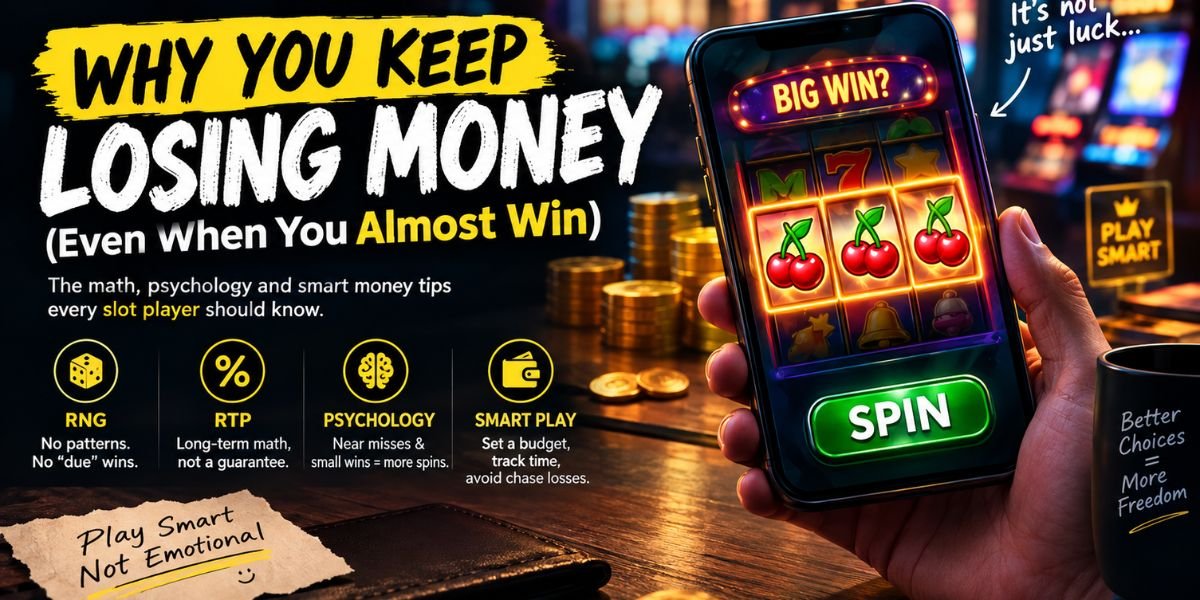
Imagine: it’s a Friday night, you’ve had a long week, and you decide to unwind by trying an online slot game your friend mentioned. You put in ₹500 “just for fun.” Twenty minutes later, you’re down to ₹50, but you just got three cherries in a row and feel like the big win is right around the corner. So you top up again.
Sound familiar? You’re not alone, and you’re definitely not “bad at slots.” The truth is, online slots are built — mathematically and psychologically — to keep you playing. Once you understand what’s actually happening behind that spinning screen, you can make far smarter decisions with your money, whether that means playing more mindfully.
Let’s break it down like a friend would, no jargon, no lecture.
What’s Really Happening When You Hit “Spin”
RNG Slot Simulator
Every online slot runs on something called a Random Number Generator (RNG). Think of it like a super-fast, computerized dice roll that happens the instant you click spin. It has no memory of your last dozen spins, no idea you’ve been “due” for a win, and no built-in sense of fairness or mercy.
This matters because a lot of people believe in patterns — “it hasn’t paid out in a while, so it must be close.” That’s simply not how it works. Each spin in online slots is an independent event, just like flipping a coin. Getting heads five times in a row doesn’t make heads or tails more likely on the sixth flip.
How to Play Online Slots for Beginners
There is Youtube Video Which is Best For Beginners
The Number That Actually Matters: RTP
If there’s one term worth remembering, it’s RTP, or “Return to Player.” This is a percentage that tells you, over a very large number of spins (think millions, not the twenty you played on your lunch break), how much money the game pays back to players on average.
Here’s a simple example: if a slot has an RTP of 96%, that means for every ₹100 wagered across all players over time, about ₹96 gets paid back out, and ₹4 stays with the casino. That ₹4 is called the house edge.
Now, here’s the part that trips people up: RTP is calculated over millions of spins, not your one session. In your 20-minute session, you could win big, lose everything, or land somewhere in between — the RTP doesn’t protect you from a rough night. It just tells you the game’s long-term math is quietly tilted against you.
Practical example: Two slot games might both look fun, but one has a 94% RTP and the other has a 98% RTP. Over time, the second one loses you money more slowly. If you’re going to play at all, checking a game’s RTP (most reputable sites list it in the game info) is like checking the fine print before signing anything financial — because it basically is one.
Why It Feels So Close to Winning (Even When You’re Losing)
Ever notice how often the reels almost line up for a jackpot? That’s not an accident — it’s a well-documented design feature called a “near miss.” Game designers know that almost winning triggers the same excitement in your brain as an actual win, which keeps you spinning.
Similarly, “small wins” — where you bet ₹20 and win ₹15 — are often shown with flashing lights and celebratory sounds, even though you technically lost money. Your brain registers it as a win because of the presentation, not the math. This is the same psychology behind why free samples at grocery stores work, or why credit card “rewards points” make spending feel less real.
Recognizing these tricks doesn’t make you immune to them, but it does make you more aware — and awareness is the first step toward spending intentionally instead of reactively.
Our platform focuses on providing fair and transparent entertainment — here is what’s worth knowing before you play.
Treating This Like a Personal Finance Decision
Use this calculator to check your risk before playing online slots.
Slot Survival Calculator
Since this is a money blog, let’s talk numbers the way we would about any other spending category.
- Set a session budget before you start, not during. Decide ₹500 is your “entertainment spend” for the night, the same way you might budget for a movie ticket or dinner out. Once it’s gone, it’s gone — no exceptions, no “just one more spin to break even.”
- Never treat it as a way to recover losses. “Chasing losses” — increasing your bets to win back what you lost — is one of the fastest ways a small entertainment budget turns into a real financial problem.
- Separate it from essential money. Use a separate prepaid card or wallet with a fixed amount, not your main bank account. This creates a natural stopping point.
- Track the time, not just the money. Set a 20-30 minute timer. Slots are designed to make time disappear; a timer brings you back to reality.
- Ask “what is this actually costing me per hour?” If you spend ₹1,000 over 45 minutes, that’s a real cost for that entertainment — compare it honestly to other ways you could spend that time and money.
A Quick Gut-Check Before You Play
Before spinning, ask yourself: Would I be okay never seeing this money again? If the honest answer is no, that’s valuable information about whether this is really “just for fun” right now, or whether it’s become something else.
There’s no shame in enjoying occasional entertainment. The goal here isn’t to scare you away from having fun — it’s to make sure you’re choosing to play with clear eyes, rather than being quietly nudged along by clever design and a few lucky-looking near misses.
Quick Summary
- Online slots run on a Random Number Generator — there’s no “pattern,” no game being “due” for a payout.
- RTP (Return to Player) shows the long-term house edge; higher RTP means the game takes less of your money over time, but it doesn’t protect any single session.
- “Near misses” and flashy small wins are designed to keep you engaged, even when you’re losing money overall.
- Treat slot spending like any entertainment budget: set a firm limit ahead of time, use separate funds, track your time, and never chase losses.
- The real financial win here is simply understanding the math and psychology well enough to make an intentional choice — not an emotional one.
Disclaimer
Warning: Underage gambling is strictly prohibited (18+). This game involves financial risk and can be addictive. Please play responsibly.
If gambling ever starts to feel like it’s affecting your finances or well-being, reach out to a local support service — recognizing it early is what real control looks like.
Frequently Asked Questions
Q. Are online slots rigged?
Answer: Licensed, regulated slot games aren’t “rigged” in the sense of cheating you individually — but they are mathematically designed so the house wins over time (that’s the RTP/house edge we covered above). Stick to sites that are licensed and list their RTP, and avoid unregulated platforms where there’s no way to verify fairness at all.
Q. Can I predict when a slot will pay out?
Answer: No. Since every spin uses a Random Number Generator, there’s no pattern, cycle, or “hot streak” to track. Any strategy claiming to predict spins is not based on how the games actually work.
Q. What does “volatility” mean on a slot game?
Answer: Volatility (sometimes called variance) describes how spread out the wins are. A low-volatility slot pays smaller amounts more often; a high-volatility slot pays rarely but can pay big. Neither changes your long-term odds — RTP does that — but it changes how bumpy your short-term experience will feel.
Q. Is a higher RTP always the better choice?
Answer: Generally yes, if you’re comparing similar games, since it means the game returns more of your money over the long run. But remember RTP is a long-term average, not a promise for your session — a 98% RTP game can still have a losing night.
Q. How much should I budget for playing?
Answer: Treat it exactly like any other entertainment expense: decide on a fixed amount you’re fully comfortable losing before you start, separate from essential funds like rent or bills, and stop once that amount is gone.
Q. What’s the difference between RTP and my actual odds of winning?
Answer: RTP tells you the average payback percentage across millions of spins for everyone who plays — it’s a statistic about the game, not a personal guarantee. Your actual result in any single session can be very different from the RTP number.

Hi, I’m Ritik, and I write about online gaming, card games, and their history, rules, and safety practices. I’m passionate about responsible gaming awareness and I try to give beginners accurate, helpful information. I’ve been researching and writing in this niche for 2 years.